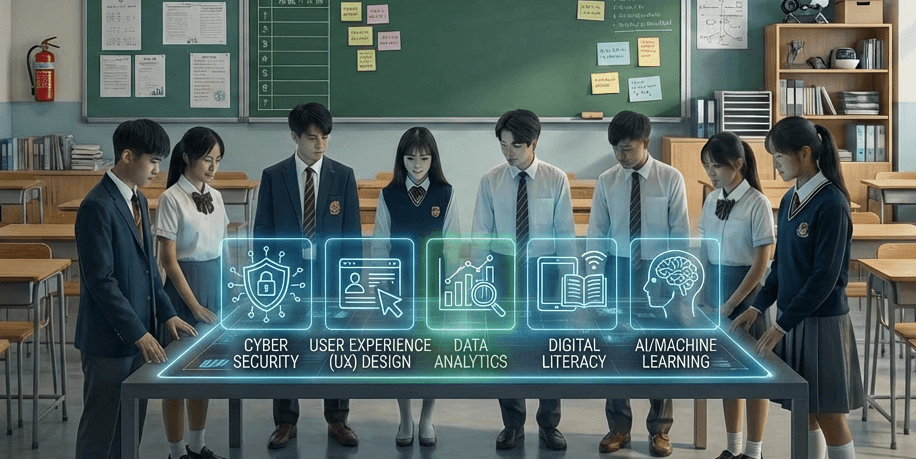

Essential Reading for Educators: How to Build a Technology Education Advantage for Your School

As artificial intelligence, cloud services and data tools rapidly transform industries across the board, digital education in Hong Kong schools is no longer simply a matter of "teaching students to use computers." As stated in the Education Bureau's Digital Education Blueprint for Primary and Secondary Schools, schools are expected to incorporate digital education into their School Development Plans and/or Annual School Plans in the 2026/27 school year and to formulate school-based implementation strategies.¹ This means that the systematic planning of information technology education has officially become a whole-school undertaking.
For principals and teachers, the real challenge is not whether to implement digital education, but rather how to translate policy requirements into genuine student competencies and into educational outcomes that parents and the community can see.
This guide provides curriculum maps and planning frameworks for educators, helping principals, curriculum leaders and IT subject heads to systematically plan school-based digital education.
1. The Core Shift Brought by the Blueprint: From "Having Technology Tools" to "Educational Purpose"
The Education Bureau's Digital Education Blueprint for Primary and Secondary Schools is underpinned by the core philosophy of "students as the foundation, teachers as the professionals, schools as the base, and society as the partner." As stated in the document, digital education involves an overall transformation in educational quality, learning equity, talent development and cross-sector collaboration, rather than a purely technical upgrade.²
According to the Blueprint, the four key development priorities are:
- Talent Development: Nurturing students with both digital literacy and a humanistic spirit
- Teacher Development: Strengthening teacher training and driving the digital transformation of education
- Smart Campus: Optimising infrastructure and establishing smart campuses
- Cross-sector Collaboration: Promoting cross-sector cooperation and building a digital education ecosystem
The implication of this framework for schools is that IT education can no longer be shouldered solely by the computer subject or individual teachers. Digital education encompasses curriculum, assessment, student development, teacher professional development and home-school communication, and therefore requires cross-departmental coordination.
Of particular importance, the Blueprint places AI literacy, information literacy, teacher professional development and smart campus development within the same policy context. The Education Bureau has simultaneously published the AI Literacy Learning Framework for Primary and Secondary Schools and the Guide to Using AI in Teaching for Primary and Secondary Schools to support schools in integrating AI education into the curriculum and into learning and teaching.³ Schools are not merely expected to teach students to "use" tools; they must also help students discern information credibility, develop data literacy, protect personal privacy, respect copyright and maintain a sense of responsibility when using technology. The Education Bureau has also emphasised the importance of cybersecurity, privacy protection, correct values and "technology for good."⁴
Accordingly, a competitive school-based technology education program should nurture three categories of competency:
- Technical Competency: Understanding and application of data tools, coding, artificial intelligence and cloud services
- Problem-solving Competency: Analysing problems, designing solutions, testing and refining
- Humanistic and Ethical Competency: Privacy, security, copyright, fairness and the impact of technology on society
2. Five Steps: Translating Digital Education into a School-Based IT Education Advantage
Step 1: Establish a Clear Digital Education Direction
Every school need not adopt the same model of technology education. The key is to establish a clear and coherent direction based on the school's context, student profile, teacher strengths and community resources. The Education Bureau's policies and related documents allow schools to plan and progressively implement relevant measures according to their own circumstances, teacher and student needs, and existing resources.¹
Principals may begin by reflecting on the following questions:
- What digital literacy and competencies, as covered by IT education goals, should students possess upon graduating from secondary school?
- Can the school's technology education extend to artificial intelligence, data analytics, cybersecurity and cloud services, rather than being limited to coding and robotics?
- How can technology education be connected to cross-disciplinary areas such as languages, science, mathematics, humanities and visual arts, rather than remaining a co-curricular activity?
- Does the school's digital education profile address parents' concerns about university admission and future-ready skills?
A distinctive school-based profile is not about pursuing the most expensive equipment, but about establishing a clear learning pathway. For example, a secondary school might adopt "Data and People" as its thematic focus: at the junior secondary level, students learn information searching, information literacy and spreadsheet fundamentals; at the senior secondary level, data visualisation, AI applications and community issue analysis are introduced; ultimately, students conduct data-driven research projects addressing community needs. This kind of pathway builds student portfolios, teacher experience and school branding more effectively than a one-off coding competition.
Step 2: Use a Curriculum Map to Integrate IT Education and Replace Fragmented Activities
Common digital education activities in schools include AI talks, STEAM Days and robotics competitions. However, without shared curriculum objectives and a progression framework, student learning can easily become fragmented and teachers may find it difficult to assess whether students have genuinely developed digital competencies.
A school-based digital education curriculum map can define learning content by year level, subject and competency tier, providing a traceable progression for IT education. The Education Bureau's technology education curriculum documents cover the curriculum framework for technology education, along with related curriculum documents and supplementary materials on computational thinking and coding education.⁵ In recent years, the Education Bureau has further promoted AI education under the digital education policy, strengthened mathematics and science technology education, and integrated digital education learning elements across different subjects and cross-disciplinary areas.³
Schools may refer to the following approach for building a curriculum map:

Note: This table represents SEED Foundation's suggested school-based digital education curriculum map, which may be adapted according to the school's year levels, context and existing subject arrangements.
Step 3: Place AI Literacy Back at the Core of Learning
Generative AI has led many schools to focus on concerns about plagiarism and the authenticity of student work. However, if the approach is limited to preventing misuse, valuable educational opportunities will be missed.
As stated in Education Bureau documents, the Blueprint has published the AI Literacy Learning Framework for Primary and Secondary Schools and the Guide to Using AI in Teaching for Primary and Secondary Schools, and proposes that AI education elements be integrated into the primary and secondary school curriculum.³
Schools may approach AI education across three levels:
- Understanding AI: Understanding how AI processes data and generates content, and why it may produce errors, biases or "hallucinations"
- Using AI Wisely: Employing prompt design, data verification and reflective methods to use AI as a supporting tool for learning and creation
- Critically Evaluating AI: Discussing privacy, data sources, algorithmic bias, academic integrity and the impact of technology on society
For example, in Chinese Language, students can compare AI-generated texts with reliable sources and identify insufficient arguments; in Civic Education, students can discuss how algorithms influence the information they receive; in IT education, students can explore how training data affects AI outputs. Such learning designs cultivate students who know how to question, judge and use AI responsibly.
Step 4: Teacher Professional Development is the Core Investment in School Transformation
Technology equipment can be purchased and platforms can be subscribed to, but teachers' professional competency cannot be resolved through procurement.
According to the Digital Education Blueprint for Primary and Secondary Schools and related professional development arrangements, teachers are required to complete no fewer than 30 hours of digital education training within every three-year, 150-hour continuous professional development (CPD) cycle. The Education Bureau also supports teachers through tiered and diversified training, covering topics such as AI literacy, AI integration with subjects, and AI leadership.⁷
Schools may structure teacher training across three levels:
- Foundation Level for All Teachers: Basic understanding of generative AI, information literacy, privacy and copyright, and the application of digital tools in teaching
- Subject-Specific Application Level: Assisting subject departments in designing practical "AI plus subject" or "data plus subject" learning activities
- Leadership Level: Developing a middle management team capable of planning school-based policies, leading cross-disciplinary collaboration and evaluating outcomes
The most effective teacher professional development is not merely about completing training hours, but about translating outcomes into usable lesson plans and student work. Principals may require that, following each key training session, at least one teaching resource or pilot scheme is produced for use by the subject department, so that teachers can genuinely bring training outcomes into the classroom.
Step 5: Build Parental Confidence Through Student Work
The term "digital education" can be abstract and difficult for parents to connect to their children's actual learning outcomes. If schools wish to establish a distinctive educational profile, they may translate student learning outcomes into visible evidence for parents, for example:
- App prototypes designed by students for the school or community (demonstrating design thinking and UX/UI competencies)
- Interactive charts or research reports analysing social issues using open data (demonstrating data literacy)
- Cross-disciplinary projects completed collaboratively using cloud tools (demonstrating collaborative and systems thinking)
- Student participation in interschool activities related to cybersecurity, AI ethics or information literacy
When students can clearly articulate what problem they identified, what data they collected, how they designed a solution and how they ensured privacy and fairness, such a student portfolio reflects the quality of the school's IT education more effectively than a standard presentation.
3. From Digital Education to Future Competencies: Why Students Need Exposure to Real Technology Fields
The ultimate purpose of school-based digital education is not to direct all students towards technology careers, but to equip every student with the fundamental competencies, confidence and choices needed to participate in the digital economy. This aligns with the Blueprint's direction of nurturing students' digital literacy, innovation and technology capabilities, correct values and capacity to meet future challenges.³ ⁴
Cloud computing, data analytics and UX/UI design may serve as three interconnected learning directions for understanding contemporary digital society: cloud computing gives students an initial understanding of how technology operates and supports basic digital collaboration; data analytics helps students learn how to identify problems from data and make evidence-based judgements; UX/UI design encourages students to take a people-centred approach and consider whether technology products are usable and valuable.
Together, these three directions form a complete learning framework spanning technical foundations, data thinking, and user experience with creative problem-solving. For example, a group of students hoping to improve the school event registration experience might collect opinions through a survey, use data analysis to identify pain points, design an interface prototype using UX/UI methods, and consider how cloud services might support the system. This type of cross-disciplinary project simultaneously nurtures technology competency, communication skills, empathy and project management ability, and closely aligns with the direction of smart campus development.
4. SEED Foundation: Helping Schools Translate Policy into Real Learning Outcomes
The practical difficulty faced by many schools is not a lack of policy direction, but a lack of concrete support for implementation, including teacher capacity, industry connections and curriculum design resources.
SEED Foundation is committed to developing in young people the competencies needed for the digital economy. Through practice-oriented IT education curricula, SEED helps students progress from passive technology users to digital talent capable of analysing problems, designing solutions and creating value. SEED's curriculum design aligns with the emphases of the Digital Education Blueprint for Primary and Secondary Schools on AI literacy and curriculum integration, cross-disciplinary collaboration and holistic student development.
Three core curriculum directions:
- Cloud Computing Program: Nurtures students' systems thinking about the foundations of digital services, covering cloud storage, network services, data security and digital collaboration, while connecting to the underlying logic of smart campuses and AI applications.
Learn more about the SEED Foundation Cloud Computing Program - Data Analytics Program: Introduces students to data organisation, analytical logic, visualisation and insight communication. Through real-world contexts, students develop an understanding of data ethics and privacy considerations, building deep data literacy.
Learn more about the SEED Foundation Data Analytics and AI-Assisted Technology Program - UX/UI Design Program: Guides students in learning design thinking, user research, interface design and usability testing. This program is particularly suited to cross-disciplinary projects and resonates with the Blueprint's direction of "nurturing talent with both digital literacy and a humanistic spirit."²
Learn more about the SEED Foundation UX/UI Design Program
If you are interested in exploring how SEED programs can be connected to your school's digital education planning, we welcome you to contact us to discuss school-based collaboration options.
Conclusion: Transforming the Blueprint into a Long-term Digital Education Asset for Your School
What the Digital Education Blueprint for Primary and Secondary Schools brings to Hong Kong schools is not simply an additional IT education requirement, but an opportunity to rethink educational goals. As digital technology increasingly shapes learning, work and civic participation, schools are called to cultivate not merely students who can operate tools, but future citizens who are capable of understanding, applying, critically evaluating and creating with technology.² ³ ⁴
Principals and teachers may begin with a clear digital education direction, an IT education curriculum map, teacher professional development, cross-disciplinary projects and student work showcases, and progressively integrate digital education into the school's overall development. With a clear direction and a measured pace, digital education can become not merely a policy task, but a significant educational advantage that raises learning quality, builds school identity and prepares students for the future.
SEED Foundation looks forward to partnering with schools to help students build future-ready digital competencies through practice-oriented programs in cloud computing, data analytics and UX/UI design, transforming technology knowledge into problem-solving ability, creative outcomes and real-world impact.
References:
- https://applications.edb.gov.hk/circular/upload/EDBC/EDBC26011C.pdf
- https://www.edb.gov.hk/tc/edu-system/primary-secondary/applicable-to-primary-secondary/it-in-edu/debp.html
- https://www.edb.gov.hk/attachment/tc/edu-system/primary-secondary/applicable-to-primary-secondary/it-in-edu/DEBP/DEBP_Executive%20Summary_TC.pdf
- https://www.edb.gov.hk/tc/about-edb/press/insiderperspective/insiderperspective20260625.html
- http://edb.gov.hk/tc/curriculum-development/kla/technology-edu/curriculum-doc/index.html
- https://www.edb.gov.hk/attachment/tc/edu-system/primary-secondary/applicable-to-primary-secondary/it-in-edu/DEBP/SupplementIIGuideToUsingAIInTeaching(PrimaryAndSecondarySchools)_TC.pdf
- https://www.edb.gov.hk/tc/edu-system/primary-secondary/applicable-to-primary-secondary/it-in-edu/debp-pdp.html