
How Our Programs Respond to EDB ”Blueprint for Digital Education Development in Primary and Secondary Schools”
In June 2026, the Education Bureau officially published the Blueprint for Digital Education Development in Primary and Secondary Schools, requiring all publicly-funded schools to incorporate digital education into their School Development Plans starting from the 2026/27 school year. Concurrently, the Government has disbursed a one-off HK$500,000 "Smart Learning and Teaching" grant to each school, requiring them to formulate school-based implementation strategies.¹ ² ³
Dr. Choi Yuk-lin, Secretary for Education, clearly stated in the Legislative Council that the core objective of promoting digital education is:
"To ensure that every student, regardless of their background, has access to fair and high-quality digital learning opportunities."⁴
The core requirements outlined in the Blueprint encompass three dimensions: comprehensively enhancing students' AI literacy, building a digitally empowered professional teaching team, and developing an overarching school-wide digital education plan. The Education Bureau further specified that the AI literacy learning framework must cover areas including "information technology, design thinking, data processing, media literacy, and ethics", with "human-machine collaboration and timely, appropriate use" as core objectives.⁵ ⁶
In reality, however, many schools face multiple challenges, including insufficient curriculum resources, difficulties in teacher deployment, and a lack of experience in school-based planning. The most fundamental obstacle lies in the gap between curriculum depth and scale. Introductory experience-based courses are generally not difficult to fill, but at the senior secondary level — when students are preparing for their career directions — what truly makes a lasting difference is sustained, in-depth coursework. Such programs require students to have a clear interest and long-term commitment, yet individual schools may struggle to recruit sufficient numbers on their own. The heavier administrative burden these courses place on schools means that even well-intentioned institutions often find it difficult to run them independently, leaving students who wish to pursue deeper learning without the opportunity to do so.
SEED Centre: Responding to the Equity Commitment Through a Shared Model
The SEED Centre "Network Partner Program", developed through a collaboration between SEED Foundation and The Association of Hong Kong Chinese Middle Schools, is designed precisely to break through this structural barrier. The core operating model of SEED Centre is to bring together students from schools across all 18 districts of Hong Kong to study programs together in a shared campus setting. This means that even if a school is unable to run a class on its own, students can still access SEED Centre's cross-school platform network and learn advanced digital skills, no longer constrained by the resources or student numbers of any individual school.
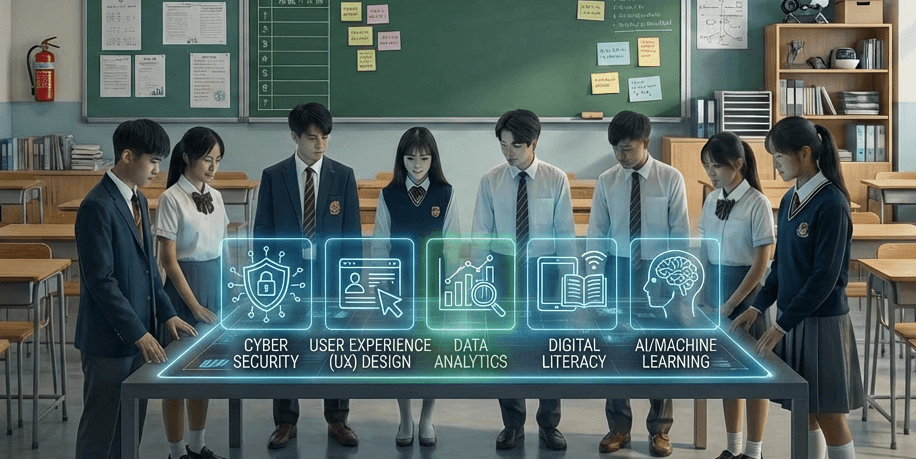
Through SEED Centre, students can pursue three learning pathways aligned with future career directions, according to their individual interests and abilities: Data Analytics and with Assistive AI, Cloud Computing, and User Experience and Interface Design. These three areas cover the complete creation process of digital products — from back-end computing and data application to user experience — addressing the core growth trends of the global digital economy and meeting Hong Kong's demand for cross-disciplinary talent in its innovation and technology industry. The programs are centred on practicality and real-world application, and include a workplace experience program that allows students to put what they have learned into practice in authentic industry settings, building a solid foundation for progression to higher education and the workplace.
Learn more about the SEED Centre
SEED Foundation: Three Learning Pathways Towards Digital Education Goals
The following outlines, for each of the three programs, how SEED Foundation's curriculum design aligns with the policy directions and learning objectives of the Education Bureau's Blueprint for Digital Education Development in Primary and Secondary Schools, the Information and Communication Technology Curriculum and Assessment Guide (Secondary 4 - 6), and the Hong Kong Students' Information Literacy Learning Framework.
Program 1 | Cloud Computing Program
The SEED Cloud Computing Program centres on hands-on operation of real cloud platforms, deepening the study of networking and cloud computing within the ICT curriculum, complementing STEAM and innovation and technology talent development policies, and strengthening students' awareness of information security and digital responsibility in cloud environments.
The program covers core cloud computing concepts (IaaS, PaaS, SaaS, serverless computing), virtualisation technology, networking fundamentals, Linux system operations, cloud storage, cloud security, and data protection. In the advanced stage, students undertake hands-on tasks on real cloud platforms, including server configuration, access management, database setup, and auto-scaling.
Relevance to Hong Kong Education Policy
The Education Bureau's current Information and Communication Technology Curriculum and Assessment Guide (Secondary 4 - 6) covers computer networks, internet communication protocols, and cloud services.⁷ The SEED Cloud Computing Program builds from foundational networking concepts to system administration and security configuration in real cloud environments, and can be regarded as a deepening and extension of schools' ICT teaching in the area of cloud applications.
With regard to information security, the Hong Kong Student Information Literacy Learning Framework emphasises that students should demonstrate security awareness and a responsible attitude when using information technology.⁸ ⁹ The program covers identity and access management, data protection, and information ethics from the introductory level, helping students develop a sound sense of digital responsibility within cloud environments.
Learn more about the SEED Foundation Cloud Computing Program
Program 2 | Data Analytics and with Assistive AI Program
The SEED Data Analytics with Assistive AI Program uses real business and public datasets as its primary material, enabling students to master the complete workflow from data collection, cleaning, and analysis to visualisation and reporting, while exploring topics such as privacy, bias, and model interpretability. The program responds to the Education Bureau's digital education and information literacy learning framework requirements, and lays a foundation for students aspiring to pursue higher education in artificial intelligence and data science. Structured across three progressive levels, the content covers data types and lifecycle, spreadsheet operations, basic statistical analysis, Python and Pandas, BigQuery and SQL, AutoML, Tableau data visualisation, and data ethics and privacy.
Relevance to Hong Kong Education Policy
The Education Bureau has clearly emphasised the importance of incorporating innovation and technology elements — including AI education into the curriculum, while also stressing the need for students to learn to "use digital technology effectively and ethically".¹⁰ ¹¹ ¹² ¹³ The SEED Data Analytics with Assistive AI Program not only teaches tool operation, but also uses AutoML and Explainable AI (such as SHAP) to demonstrate the working principles and limitations of models, guiding students in in-depth discussions of bias, privacy, and ethical issues — closely aligned with this policy direction.
From a university articulation perspective, the University of Hong Kong's Faculty of Computing and Data Science launched its new "Computational and Data Science" program in the 2025/26 academic year, emphasising technical competencies such as data analysis, Python, and SQL.¹⁴ ¹⁵ The technology stack used in the SEED program, including Python, SQL, BigQuery, and Tableau — comprises tools widely adopted in higher education and industry, providing students who intend to pursue related university programs with an important preparatory experience.
Learn more about the SEED Foundation Data Analytics with Assistive with Assistive AI Program
Program 3 | UX/UI Design Program
The SEED UX/UI Design Program uses social issue-themed website design projects to integrate user research, human-centred design and usability testing, enabling students to apply design thinking and innovation and technology tools in real-world contexts. The program supports schools in delivering relevant learning objectives within the Education Bureau's Technology Education curriculum and Information Literacy Learning Framework. Content covers UX/UI fundamentals, digital design principles, colour theory, user research, Human-Centred Design (HCD), prototyping, and usability testing, and incorporates generative AI tools to assist with image creation and design workflows.
Relevance to Hong Kong Education Policy
The "Design and Applied Technology" subject within the Education Bureau's Technology Education curriculum encourages students to apply design thinking, cultivating flexible and creative thinking skills so that they understand how to conceptualise, develop, and implement design ideas.¹⁶ The SEED UX/UI Program uses social good issues as design themes, requiring students to work through every stage of the design thinking process — from problem definition and user research to goal-setting and the production of high-fidelity website prototypes, followed by usability testing.
From an information literacy perspective, the Hong Kong Student Information Literacy Learning Framework proposes that students should be able to create and evaluate digital products, taking into account the clarity and accessibility of information presentation.¹⁷ The SEED Program incorporates human-computer interaction, usability evaluation, and digital design principles, supporting schools in achieving the learning outcomes related to digital product design and evaluation within the framework.
Learn more about the SEED Foundation UX/UI Design Program
Why Are These Three Programs Particularly Important Right Now?
The challenge of digital education has never been solely a matter of resources or hardware. It is fundamentally about how to provide students with genuine, hands-on opportunities. School curricula have their systemic strengths, but deep practical engagement with innovation and technology, hands-on experience with real industry tools, and exposure to workplace culture are often difficult to fully cover within limited teaching hours.
SEED Centre plays a vital role in this space. The three programs correspond to cloud technology, data processing, and design thinking — three core competency areas of the innovation and technology industry. They are closely aligned with the Education Bureau's existing curriculum and policy directions, while providing students with real-world practical experience that goes beyond the classroom, enabling policy objectives to truly take root.