IdeaPOP! 2026 Participants | Sing Yon Jockey Club Addresses the Medical Challenges Faced by the Hearing Impaired Through Sign Language Translation
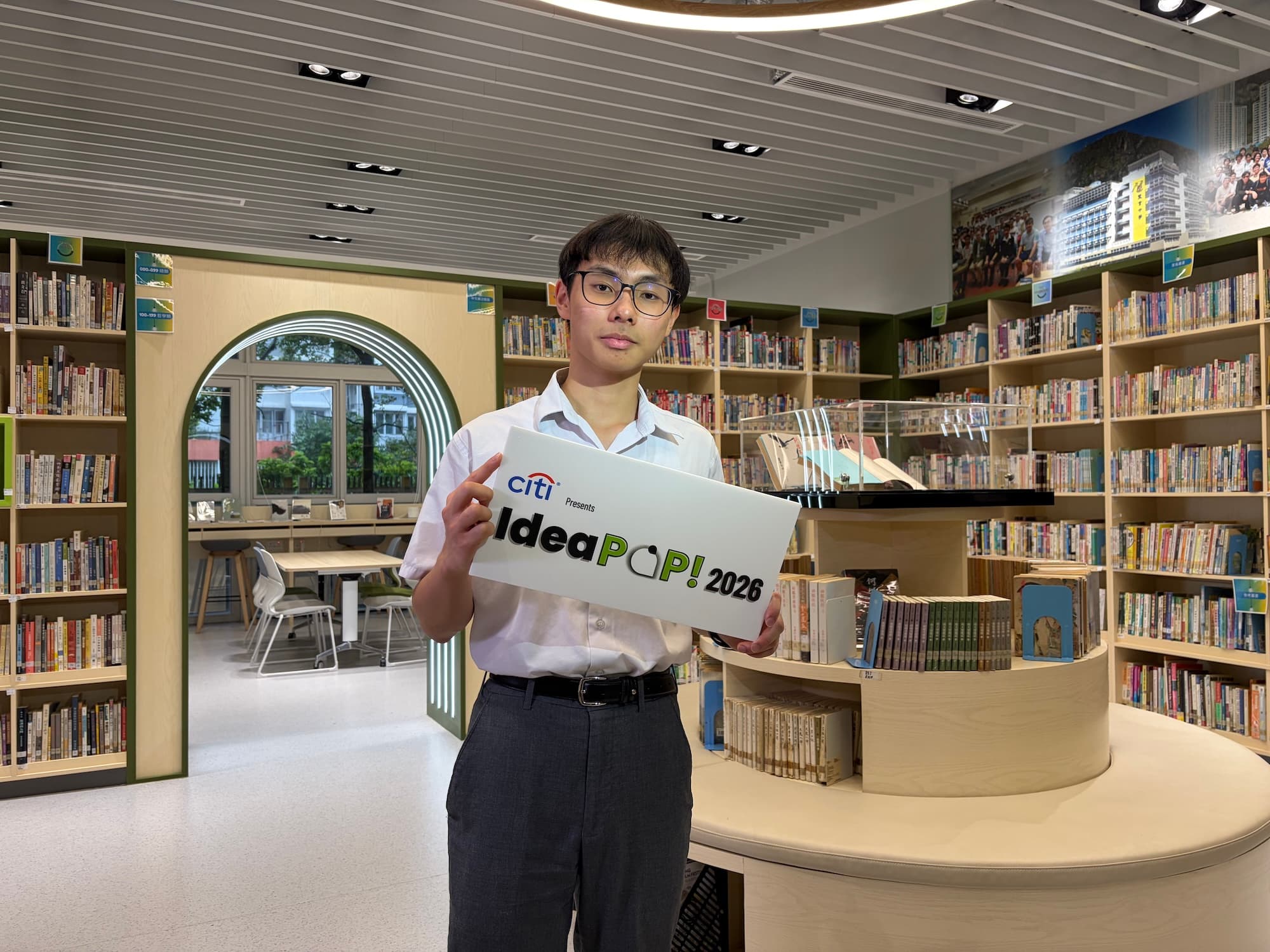
In the IdeaPOP! 2026 Secondary School Startup Pitch Competition, the Sing Yon Jockey Club team from Sing Yon Secondary School designed a sign language translation app called Signlink, hoping to build a bridge between sign language and spoken language so that hearing impaired individuals can more accurately express their needs when seeking medical care.
Team representative Mak shared that IdeaPOP! 2026 taught him how to "turn an idea into something real from scratch." This journey was not just a technical exploration, but a repeated process of trying to truly understand the lived experiences of their users.
From Multiple News Reports to the Outline of a Problem
The starting point of Signlink was a series of news reports about the communication difficulties hearing impaired individuals face when seeking medical care.
From these reports, the team pieced together a situation they had never truly imagined before: when a hearing impaired person visits a hospital emergency room, the hospital may not be able to arrange an interpreter on the spot; even with an advance booking, it is not always guaranteed. In the end, patients often have no choice but to communicate with medical staff using pen and paper.
However, for many hearing impaired individuals, the grammar of sign language and written language are fundamentally different. Having to rely solely on pen and paper to express symptoms in a tense and urgent consultation environment is a barrier that is genuinely difficult to overcome.
After recognising this barrier, they began to ask: could technology make this communication a little easier?
From an AI Architecture, Seeing the Possibility of Translation
While thinking about how to improve translation accuracy, Mak came across an AI architecture called Transformer.
"We noticed something called the Transformer architecture and proposed trying to see if it would work. We started researching and found that it was actually quite suitable."
Mak used the analogy of reading a book to explain how Transformer works: earlier models were more like reading word by word from beginning to end, whereas Transformer is more like scanning an entire page at once and understanding the meaning of a passage through its context. Even if a few gestures along the way are not perfectly standard, the system can still arrive at a more accurate judgement by drawing on the overall context.
For sign language translation, this is key. Different people may not sign in exactly the same way, and gestures are not always perfectly standard every time. What matters is not a mechanical one to one matching of individual gestures, but whether the system can understand what the user truly intends to express.
This is also why they believe Transformer is well suited for sign language translation: translation is not just about recognising movements, but about understanding context.
Technology Can Be Borrowed, But the Database Must Be Built From Scratch
Initially, the team had planned to build the entire system from the ground up: from skeleton extraction and AI model integration, to translating each sign language gesture into sentences, completing every step themselves.
However, as their research deepened, they found that tools such as Google's MediaPipe were already capable of handling human pose and hand joint detection with great reliability, and the Transformer architecture had already been widely adopted. What was truly limiting the product's development was not the technical framework itself, but the lack of a sufficiently comprehensive, accurate, and contextually grounded sign language database.
"So in the end, we shifted our direction to developing a more comprehensive database."
Rather than reinventing existing tools, it made more sense to direct their resources towards what was genuinely missing. The direction changed, but the problem they wanted to solve remained the same: how to make sign language translation more accurate, more practical, and closer to the authentic way hearing impaired individuals express themselves.
Seeing the Real Users: When the Product Meets Middle Aged and Elderly Hearing Impaired Individuals
One finding during the development of Signlink prompted the team to rethink the entire user interface.
"During data collection, we discovered that the vast majority of the hearing impaired community consists of middle aged and elderly individuals."
This finding changed how they envisioned the product. If the primary users are middle aged and elderly people, every detail needs to be reconsidered, including the complexity of the interface, font size, button placement, and the overall flow of operations.
"If the interface is too complicated or too elaborate, it might be harder for them to operate and would add to their burden."
As a result, the team ultimately chose large fonts, a simple interface, and intuitive navigation as their design direction.
The true value of a product has never been solely about how advanced its technology is, but whether the person actually walking into a hospital can use it effortlessly at the moment they need help the most.
Letting Everyone Speak Their Own Needs in Their Own Language
The scenario Mak most hopes to see Signlink deployed in is hospital consultations.
That is the moment when hearing impaired individuals most need to be accurately understood, and also the moment when communication barriers are most likely to lead to serious consequences. Without an interpreter, they can only rely on pen and paper to express themselves, but the words written down may not fully convey the symptoms and feelings they truly want to communicate.
"If hearing impaired individuals are able to use the way they are most comfortable with, expressing their true condition and their true symptoms through sign language, doctors can then make a more accurate diagnosis."
Through Signlink, hearing impaired individuals no longer need to force their feelings into written words, but can instead describe their physical condition directly in their own familiar language, reducing the risk of misunderstanding or even misdiagnosis caused by unclear communication.
Letting a person speak their pain in their own language. That is the reason Signlink exists.
IdeaPOP! and What Makes It Different From Other Competitions: Entrepreneurship Is About Responding to Real Needs
Mak has participated in many competitions, and he believes the biggest difference between IdeaPOP! and other competitions lies in the fact that the core of its evaluation is not just how innovative an idea is, but whether the product can genuinely respond to social needs and help those who need it.
This standard ran through their entire product development process: from initially reading reports about the difficulties hearing impaired individuals face when seeking medical care, to researching technical frameworks, adjusting the database direction, and redesigning the interface and features. Every step started from the same place: real users and real needs.
During the process of participating in IdeaPOP!, Mak designed a product from scratch together with his team for the first time, learning every aspect firsthand, from product concept and technology choices, to financial planning and pitch presentation. He said these are things that textbooks may not necessarily teach.
"If you normally have a lot of imaginative ideas, and you have many different ideas you want to share, but you do not have a platform to share them on, IdeaPOP! is a wonderful platform for you to put them into practice and to present your ideas to mentors."
He encourages students who are still hesitant to take the first step. Because some ideas only gradually become a product that can be used, tested, and potentially truly help people when you actually start trying.


